TIP TIG vs. MIG/MAG: MIG Speed with TIG Quality
TIP TIG delivers MIG-class deposition without giving up TIG quality — at roughly half the heat input, with no spatter and no rework. How it compares to MIG/MAG.
MIG/MAG is the high-volume workhorse of welding: fast, high deposition, easy to automate — but it pays for that speed in heat, spatter, and fusion quality. TIP TIG is engineered to close that gap from the other side: MIG-class deposition with TIG quality. So the real question is not whether MIG is fast, but what its speed costs — and whether you have to accept those costs. This is how the two compare.
Deposition: the “MIG speed” half of the promise
Deposition is where TIP TIG earns the “MIG speed” claim. It delivers the highest deposition rate of any TIG process — up to about 4 kg/h and beyond depending on the application, putting it in MIG’s productivity class — and with no slag and no interpass cleaning, more of that cycle is spent with the arc on.
What separates the two processes, then, is not raw speed — it is everything around the weld. MIG carries real risks of lack of fusion, porosity, and poor weld tie-ins, it spatters, and it struggles in the vertical and overhead positions. On sluggish or corrosion-resistant alloys — duplex, Inconel, clad layers — those risks turn into rejects.
Heat input: the deciding number
The clearest, most quantifiable gap is heat input. Using the standard formula (volts × amps × 60 ÷ travel speed), a typical MIG pass runs around 923 J/mm. Conventional TIG sits at about 768 J/mm, and TIP TIG at roughly 480 J/mm — about half of MIG’s.
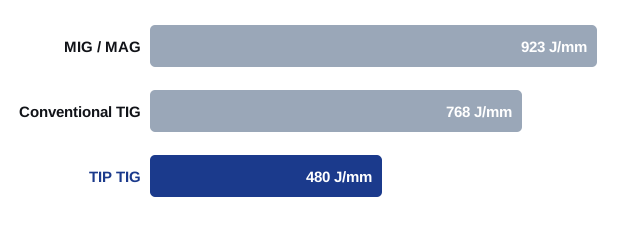
That is the payoff of matching MIG’s speed with a TIG arc: MIG-class deposition, but with the lowest heat input of the three processes. Low heat input means less distortion, a narrower heat-affected zone, and — critically on corrosion-resistant alloys — preserved corrosion properties instead of sensitization. It is the difference between a clad layer that survives the weld and one that does not.
No spatter, no rework
TIP TIG holds radiographic quality with no slag, no interpass cleaning, in all positions, on 100% argon. The no-spatter result is a practical time-saver, not just cosmetics: MIG spatter has to be chipped or ground off after welding, while TIP TIG leaves nothing to clean up — no spatter, no rework.
MIG also cannot make the same quality promise on critical joints: on ID Inconel-clad subsea pipe, pulsed MIG could not consistently meet a 100% X-ray requirement — the problem that sent CNOOC to TIP TIG. Where the code demands zero defects on a corrosion-resistant alloy, TIP TIG’s TIG-grade fusion is the safer route.
At a glance
| MIG / MAG | TIP TIG | |
|---|---|---|
| Deposition rate | High | MIG-class — up to ~4 kg/h |
| Heat input (typical) | ~923 J/mm | ~480 J/mm |
| Spatter | Yes — needs post-weld removal | None — no rework |
| Fusion / porosity risk | Elevated | TIG-grade, radiographic |
| All-position | Limited | All positions |
| Shielding gas | Argon/CO₂ mixes | 100% argon |
When to choose which
MIG/MAG still earns its place where throughput is the only priority and the metallurgy is forgiving — thick carbon-steel structures and high-volume fabrication where the tolerances leave room for its heat, its spatter, and the occasional defect.
Reach for TIP TIG when quality is non-negotiable: corrosion-resistant alloys, weld overlay cladding, code-driven pipe, thin or distortion-sensitive assemblies, and anything welded out of position to a radiographic standard. You keep MIG-class deposition — and add the lowest heat input, no spatter, no rework, and welds that pass X-ray the first time.
The short version: TIP TIG is built to give you MIG speed with TIG quality. On quality-critical work, that combination is the whole point.