Pipe welding: positions, the root pass, and what makes it hard
1G, 2G, 5G and 6G explained with a diagram: how the pipe sits in each position, why 6G is the test employers use, and why the root pass decides the weld.
Pipe is welded in four groove positions: 1G (pipe rotated), 2G (axis vertical), 5G (horizontal and fixed) and 6G (fixed at 45°). A pipe joint looks like a plate joint bent into a circle. It behaves nothing like one, and the reasons are worth being explicit about, because almost everything that makes pipe welding difficult follows from the geometry.
Why a circle is harder than a line
Three things change when the joint closes on itself.
The position changes as you go. On a fixed pipe, a single weld runs through flat, vertical, and overhead in one continuous pass. The puddle behaves differently in each, so amperage, travel speed, and torch angle all have to change while welding — and change back on the other side.
There is no back. On a closed pipe you cannot reach the underside of the root to grind, inspect, or add a backing bar. The root pass has to be right the first time, from one side, with the inside of the joint invisible until an inspector puts a camera or a film on it.
Everything is a full-penetration weld. Pipe carries something, usually under pressure, usually something you would rather not have leaking. That means codes, procedures, and a weld that has to fuse the full wall thickness rather than just hold two parts together.
The positions: 1G, 2G, 5G, 6G
The letter says the joint type — G for groove (butt) welds, F for fillets. The number says the orientation.
| Position | Pipe | Rotated? | What the welder faces |
|---|---|---|---|
| 1G | Horizontal | Yes | Welding stays flat at the top; the pipe turns under the torch. The easiest. |
| 2G | Axis vertical | No | The joint runs horizontally around the pipe; the welder works sideways. |
| 5G | Horizontal | No | The welder travels over or under the pipe — flat at the top, vertical at the sides, overhead at the bottom. |
| 6G | Fixed at 45° | No | Every position in one weld, and none of them square-on. |
| 6GR | 45° with a restriction ring | No | 6G plus an obstruction that limits access. Used for structural T, K, and Y joints. |
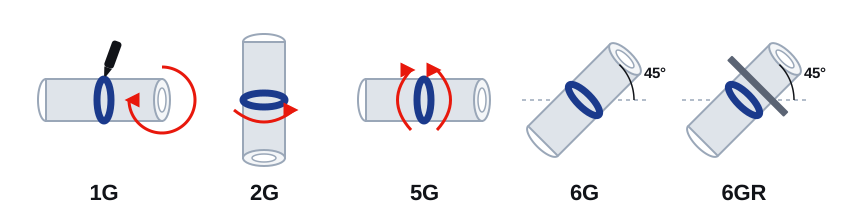
The order is also the order of difficulty, which is why 6G is the qualification test. A welder who holds quality through a 6G coupon has demonstrated every position a pipe can present.
What a specific test qualifies someone to weld afterward is set by the code — under ASME Section IX that is the QW-461 tables, and they are more nuanced than shop shorthand suggests. Read them rather than assuming.
The root pass decides the weld
Everything after the root is easier. The root itself has to do four things at once:
- Fuse both edges completely. A lack-of-fusion defect at the root is the classic pipe failure, and it hides under a cap that looks perfect.
- Form a smooth internal profile. Excess penetration hanging into the bore restricts flow, catches debris and, in hygienic service, is a rejectable defect on its own.
- Survive the position. Overhead at six o’clock, gravity is pulling the pool out of the joint.
- Not oxidize. On stainless, nickel alloys, and titanium the inside of the root sees whatever gas is in the pipe.
Three approaches, and the choice usually comes from the specification:
Open root. Beveled edges with a land and a gap, welded from outside. Cheapest fit-up, most demanding technique, and the gap has to stay consistent all the way around — which is exactly what an internal line-up clamp is for.
Consumable insert. A pre-formed ring set into the joint, melted into the root. More expensive per joint, far more consistent, common on high-purity and nuclear work.
Backing gas. Not an alternative to the above but a requirement alongside them on any alloy that oxidizes. Purge to below roughly 50 ppm oxygen before striking; the shielding gas guide covers the detail, and the stainless guide covers what happens if you skip it.
TIG is the default for the root even in shops that fill with wire or stick, for one reason: it is the only common process where the welder can see and control the pool precisely enough to get all four of those right at once.
Fit-up is half the job
A pipe weld is decided before the arc is struck.
Alignment. Two pipes that are not concentric leave a high-low mismatch that no welding technique corrects. On thin wall it is a stress raiser; on thick wall it is a rejectable defect.
Root gap and land. Both have to be consistent around the full circumference. A gap that opens up at the top and closes at the bottom gives you burn-through on one side and lack of fusion on the other.
Cleanliness. Mill scale, cutting oil, and moisture all end up in the root if they are not removed first.
This is where an internal line-up clamp earns its keep on repeat work: it aligns both ends from inside, holds the gap concentric while tacking, and on the ILUC it purges the joint at the same time — one setup instead of two.
Procedures and qualification
Pipe work is code work, and the paperwork follows a fixed shape: a PQR records a test weld and its results, a WPS tells the welder what is permitted, and a welder qualification proves the individual can execute it.
Changing how the filler is fed — from hand-fed to machine-fed — raises the question of whether the whole set has to be redone. Under ASME Section IX, less often than people assume: the type of welding is a non-essential variable for GTAW, so the WPS is revised rather than requalified. The detail is here.
Where mechanizing pays
Hand welding a pipe joint means changing parameters continuously as the position changes, for every joint, at every station, all shift. Consistency depends on the welder — and the industry does not have enough of them.
Orbital welding removes that variable. A head clamps to the pipe and carries the torch around the joint at a programmed travel speed, with the parameters set per segment of the circumference rather than adjusted by feel. The machine welds the six o’clock position exactly as it welded twelve.
Where it pays is repeat work: spool fabrication, tube-to-tubesheet, process piping, pipelay. Where it does not is one-off repairs in awkward corners, which is why shops that do both keep manual capability alongside.
TIP TIG applies hot wire to both. Manually, the wire is fed and oscillated mechanically instead of dipped, so the operator manages torch angle and travel rather than a two-handed rhythm — which shortens the learning curve on exactly the positions that are hardest to learn. Mechanized, the orbital system adds the same hot wire feed to an automated head, which is what let CNOOC weld Inconel-clad subsea joints to 100% X-ray with zero rework — the case study has the numbers.
In short
A pipe joint is a plate joint that changes position while you weld it, cannot be reached from behind, and has to hold pressure. The positions run 1G, 2G, 5G, 6G in rising difficulty, and 6G is the test because it contains all of them. The root pass decides the weld, fit-up decides the root, and both are worth more attention than the cap that everyone looks at.