TIP TIG vs. Conventional TIG: What Actually Changes
Hot wire vs cold wire TIG welding compared: travel speed, heat input, deposition, and operator skill — the numbers behind each, plus code qualification.
Conventional TIG produces some of the cleanest, highest-integrity welds available — and it pays for that quality with the lowest deposition, the slowest travel speeds, and the highest skill requirement of any common process. TIP TIG keeps the weld quality that makes TIG the choice for code-driven work, then removes the speed and heat penalty. The difference comes down to one thing: what happens to the filler wire before it reaches the weld pool.
The core difference: cold wire vs hot wire
In conventional TIG the filler wire arrives cold. Every millimeter of wire has to be melted by the arc, and it chills the pool on the way in. That forces slow travel, limits deposition, and makes the result heavily dependent on the welder’s hand skill.
TIP TIG is a dynamic TIG process. A secondary power source inside the unit applies a hot wire current to the filler so it arrives near its melting point, and the wire feeder adds a vibratory (linear forward/backward) motion that agitates the pool. Because the wire arrives hot, it flows into the pool immediately and improves wetting instead of cooling it. The tungsten still controls the primary arc, so arc control stays TIG-clean.
It runs on a conventional GTAW power supply, standard MIG wire and 100% argon — and needs no foot pedal.
Head to head
Travel speed
On pipe, TIP TIG is typically 100–300% faster than regular TIG, and fill passes run 200–300% faster. In practice, manual TIP TIG welds can look as good as orbital welds.
Heat input
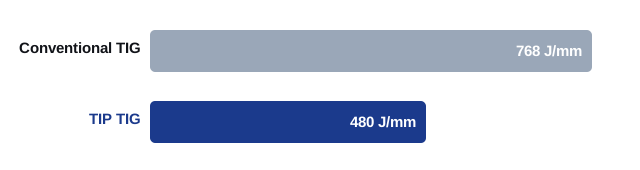
Using the standard heat-input formula (volts × amps × 60 ÷ travel speed), a typical conventional TIG pass runs around 768 J/mm. A typical TIP TIG pass runs around 480 J/mm — roughly a third less. Lower heat input means the lowest heat-affected zone, significantly reduced distortion, and better retention of corrosion properties on corrosion-resistant alloys.
Deposition
TIP TIG delivers the highest deposition rate of any TIG process, and because there is no slag and no interpass cleaning, more of the cycle is spent with the arc on.
Weld quality
Both processes run on 100% argon, in all positions, on all weldable metals. TIP TIG holds radiographic quality on demanding work — on one DN 450 Inconel pipe job it was welded root-to-cap at 100% X-ray with zero rework, with fill passes 200–300% faster than regular TIG.
Operator skill
Conventional TIG depends on the welder manually dipping the wire in rhythm with the pool — a skill that takes years. TIP TIG feeds the wire mechanically, so the operator manages torch angle and travel, not manual wire dip. The process is simple to learn, use, and teach; existing TIG welders adapt in hours.
At a glance
| Conventional TIG | TIP TIG | |
|---|---|---|
| Filler wire | Cold — chills the pool | Hot wire, near melting point |
| Travel speed | Baseline (slow) | 100–300% faster |
| Heat input (typical) | ~768 J/mm | ~480 J/mm |
| Deposition rate | Lowest of any TIG process | Highest of any TIG process |
| Interpass cleaning | — | None (no slag) |
| Shielding gas | 100% argon | 100% argon |
| Learning curve | Years of hand skill | Hours for a TIG welder |
Does it need a new qualification?
A common blocker is the fear of re-qualifying procedures. Under ASME Section IX, it is not required. The method of adding filler — by hand or by machine — is a non-essential variable for GTAW (Table QW-256, QW-410.25), so the weld properties are unaffected. To start using TIP TIG you revise the WPS to allow semi-automatic welding and to specify the wire size and feed speed — but you do not have to requalify the WPS. A welder already qualified in manual GTAW is qualified for semi-automatic GTAW; practicing on the equipment and running a test coupon to verify skill is recommended before production.
When to choose which
Conventional TIG remains a fine choice for very thin material, tack work, and one-off repairs where setup time outweighs throughput. TIP TIG makes the difference where quality and volume both matter — orbital pipe welding, weld overlay cladding, and code-driven fabrication in stainless, duplex, nickel alloys, and titanium, across nuclear, aerospace, LNG, hydrogen, and petrochemical work.
The short version: if you already trust TIG for the quality but the throughput is holding you back, TIP TIG is the process that removes the trade-off.